Resource planning
tool.
Duty rosters optimised mathematically: a constraint solver computes the plan for six locations and 27 employees – provably optimal, in under 30 seconds instead of two days of manual work.
A puzzle every single week
Several boutiques, a multilingual team, different workloads, absences, preferred days – and every branch has to be staffed correctly for every half-day: with enough people, the right languages and at least one experienced person on site. On top of that come labour-law requirements such as maximum weekend assignments, rules for the sixth consecutive working day and the correct accounting of breaks.
Until now, this plan was built by hand in Excel – around two days of work per run, during which rule violations and unfair distributions could still slip through. Our solution replaces the puzzling with mathematics: a constraint solver considers all rules simultaneously and computes a provably optimal plan in under 30 seconds.
What is automated staff scheduling? Automated staff scheduling (also called workforce scheduling or shift planning) means software computes the duty roster mathematically from all rules and availabilities instead of it being assembled by hand. A constraint solver checks every possible combination against all conditions – staffing, workloads, languages, labour law, fairness – and delivers the provably best solution.
Resource planning – duty rosters optimised automatically
For a Swiss retail business with several branches and a multilingual team, we developed planning software that computes the weekly duty roster mathematically – instead of pushing shifts around in Excel by hand.
Constraint optimisation
Google OR-Tools (CP-SAT) finds the provably optimal plan out of thousands of possibilities – 100 % deterministic, no AI at runtime.
Several branches at once
Minimum and maximum staffing per branch and half-day, language and experience requirements per location – all planned in a single run.
Fair & compliant
Weekend limits, working time in real hours, absences and preferred days – unavoidable understaffing is distributed evenly.
Finished plans as Excel & PDF
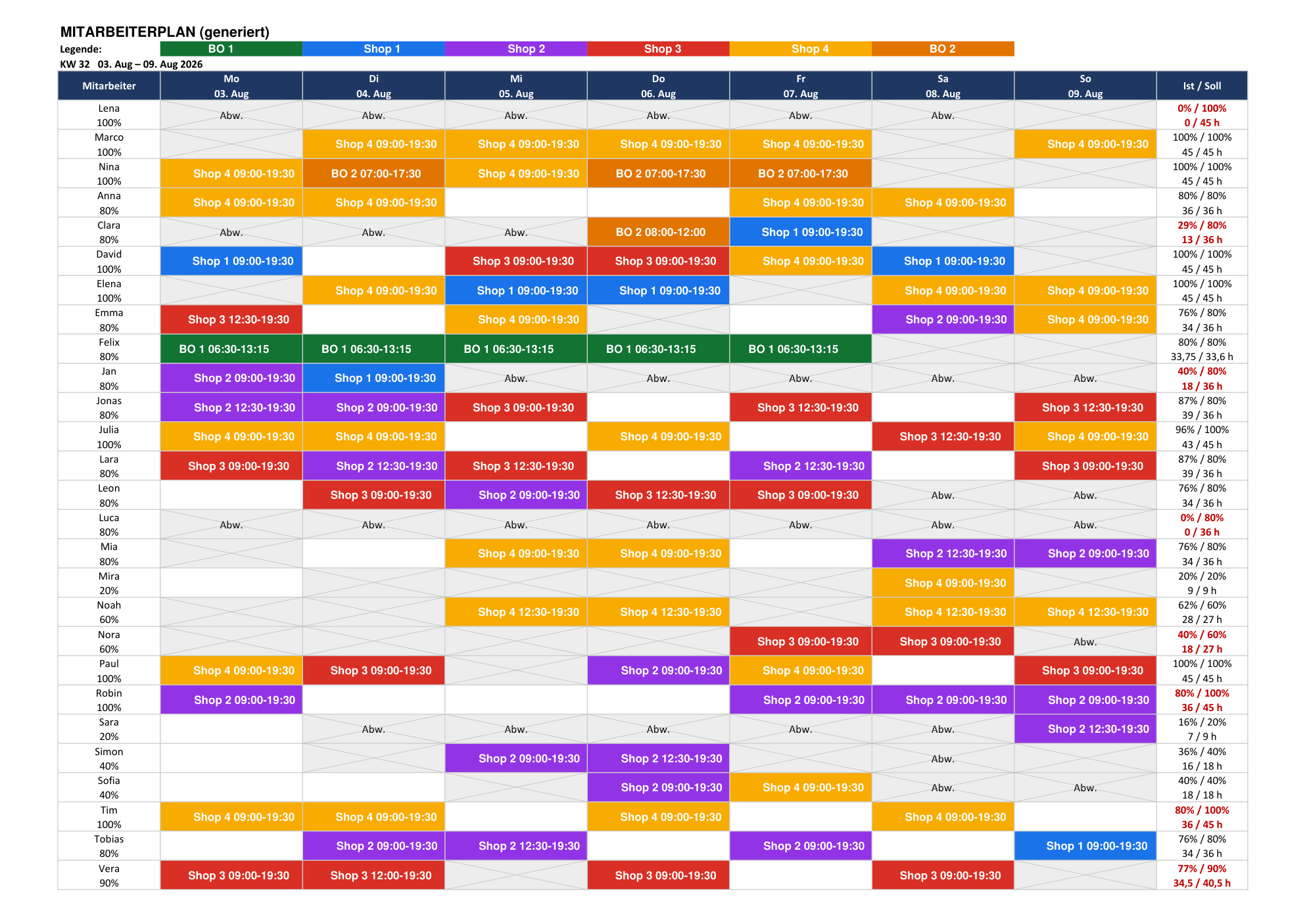
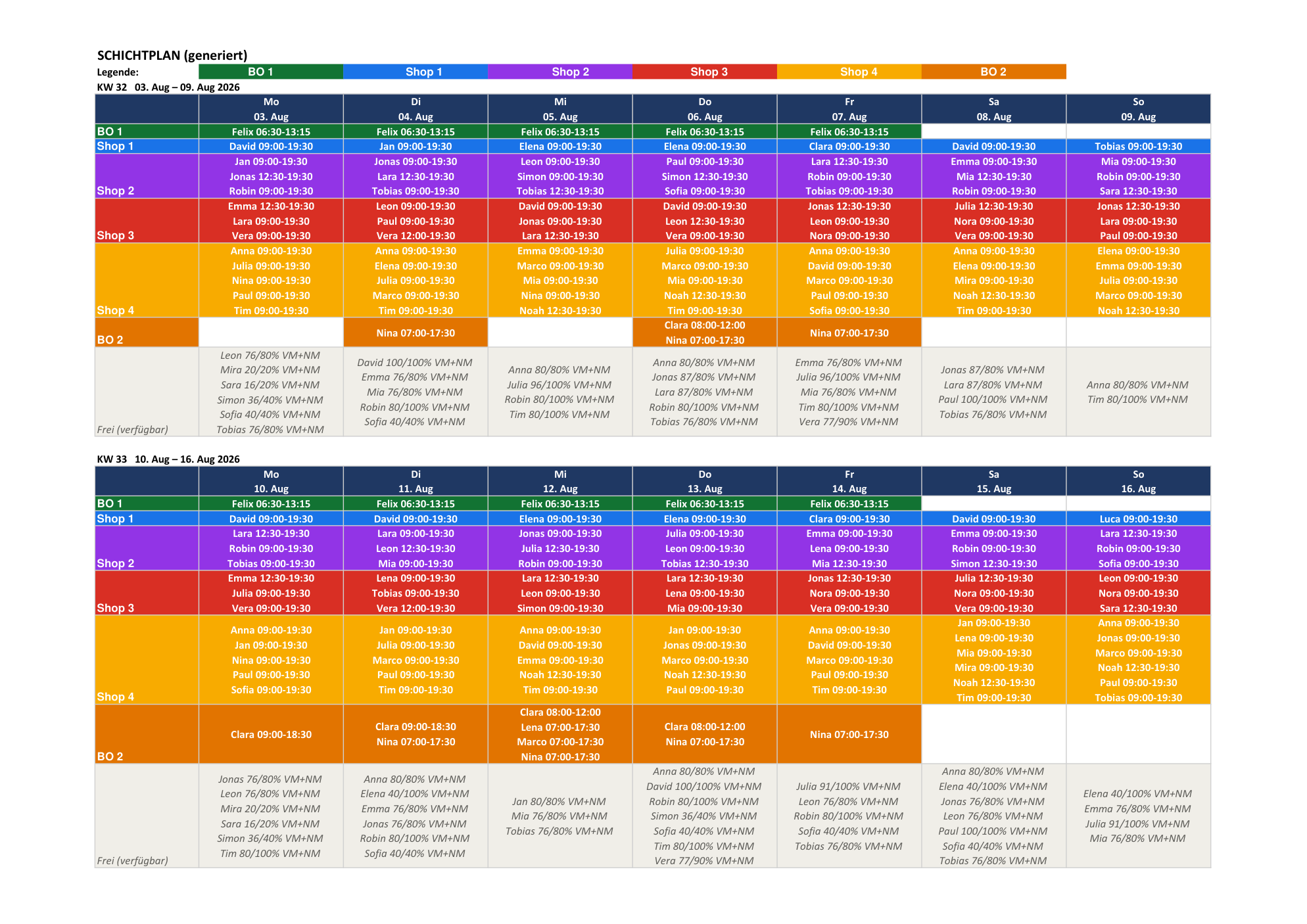
Employee and shift plans as Excel and print-ready PDF – one week per page, colour-coded and cleanly formatted.
Languages & experience
Per location you can enforce that a language-qualified or experienced person is always present – the solver guarantees it.
Weekends & working time
Maximum weekend days, sixth-day rules, break deduction and workload in real hours – mapped fairly and in line with the law.
Automatic cover for absences
If someone is out, the solver schedules a replacement automatically – for example from the warehouse to a shop. The finished plan remains manually adjustable.
Data in Switzerland
Runs either fully on-premise or on Swiss servers – personnel data stays under the company's control.
When planning gets complicated
The software fits wherever planning is done laboriously in Excel today and many rules apply at the same time:
Retail
Several branches, coverage, language and experience requirements.
Gastronomy & hotels
Cover shifts, qualifications and peak hours reliably.
Pharmacies & drugstores
Ensure qualified presence during all opening hours.
Security & cleaning
Multi-site assignments with fixed staffing rules.
How a weekly plan is created
From data entry to the print-ready plan – all in one web interface:
Enter
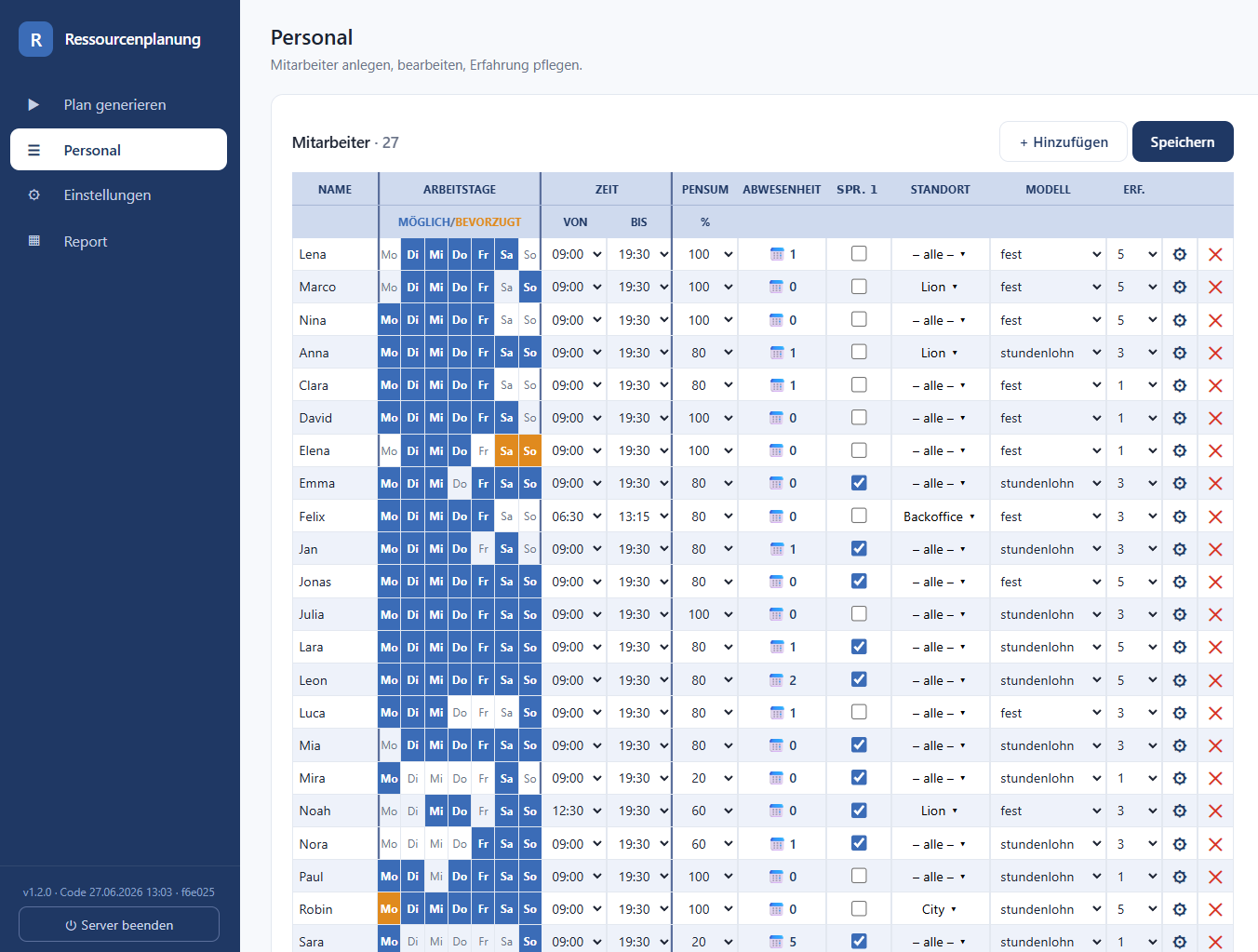
Set up staff with workload, languages, experience, working days and absences – once, then simply keep it up to date.
Define rules
Store staffing requirements per branch and half-day, fixed shifts, weekend limits and further rules.
Optimise
The solver computes the provably optimal plan out of thousands of combinations – in under 30 seconds.
Export
Finished employee and shift plans as Excel and print-ready PDF – one week per page.
Seconds instead of days.
Where around two days of manual Excel work were needed per run, the solver now delivers a provably optimal, fair plan with zero open gaps in under 30 seconds – bottlenecks are detected and reported transparently instead of being overlooked. Built with AI assistance, yet 100 % deterministic and traceable at runtime. The software runs in production, either fully on-premise or on Swiss servers.
- Weekly planning fully automated instead of manual – result remains adjustable
- 1,828 decision variables and 3,776 constraints solved simultaneously
- Fair distribution of shifts and weekends, automatic cover for absences
- Personnel data stays under the company's control
Automating staff scheduling – FAQ
What is automated staff scheduling with a constraint solver?
A constraint solver considers all planning rules simultaneously – staffing per branch and half-day, workloads, languages, experience, absences, weekend limits and labour-law requirements – and computes a mathematically provably optimal duty roster. Unlike manual Excel planning, this takes seconds instead of days, and rule violations are impossible.
Which businesses is the planning software suited for?
Anywhere many rules apply at once and planning is done laboriously in Excel today: retail with several branches, gastronomy and hotels, pharmacies and drugstores, and security or cleaning services with multi-site assignments.
How fast is an optimised weekly roster created?
In the reference project with 6 locations and 27 employees, the solver computes a provably optimal two-week plan with 1,828 decision variables and 3,776 constraints in under 30 seconds – previously around two days of manual work.
Where is the personnel data stored?
The software runs either fully on-premise or on Swiss servers, so personnel data stays under the company's control. No AI runs at runtime – the computation is 100 % deterministic and traceable.
What happens with short-notice absences?
If someone is out, the solver schedules a replacement automatically – for example from the warehouse to a shop. The finished plan remains manually adjustable and is exported as Excel and print-ready PDF.